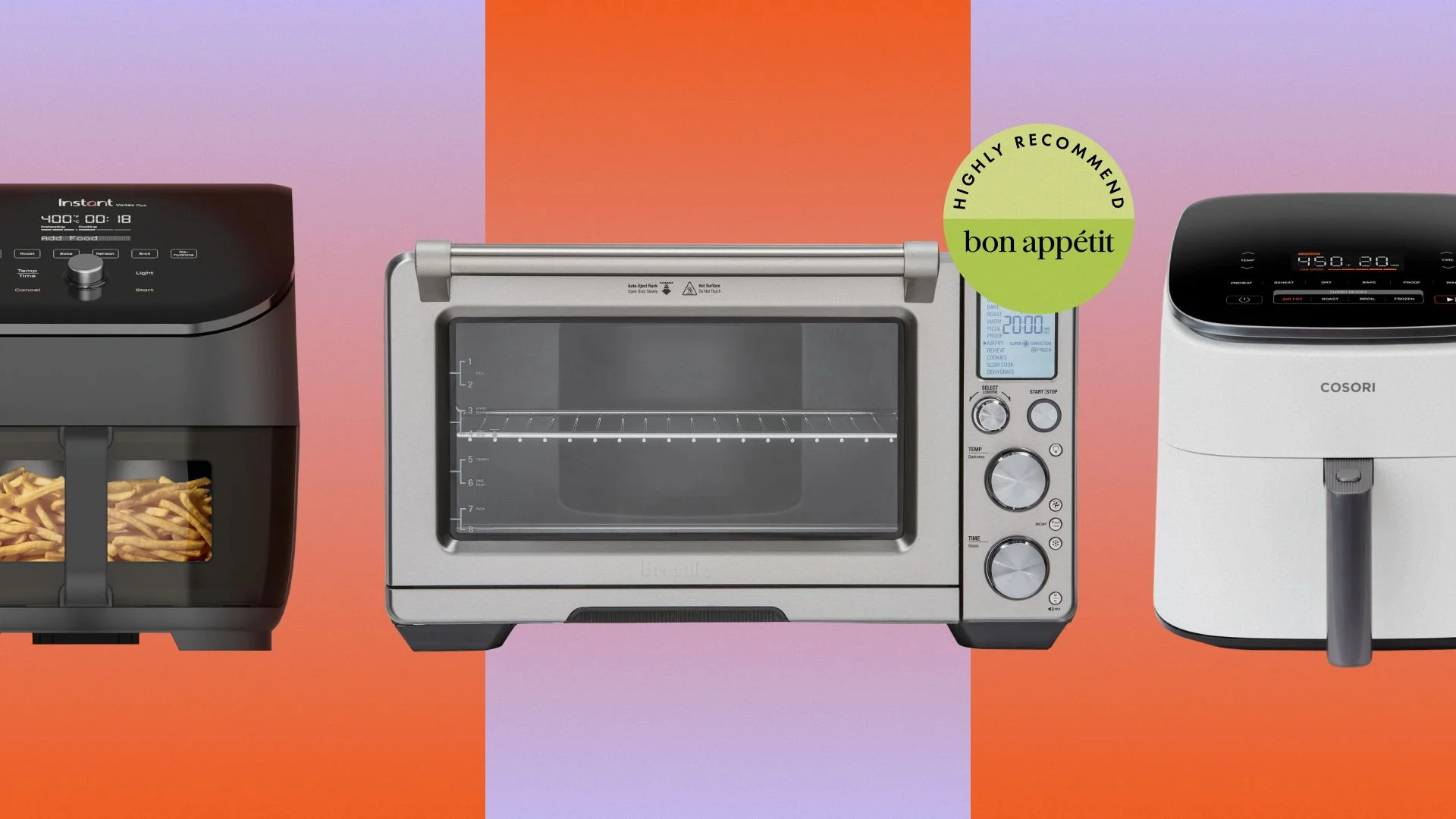
Buzzy as they’ve become over the past several years, air fryers are really just small ovens with fans built into them, i.e., convection ovens. Their fans to circulate hot air around your food, theoretically to but not all of them are created equal. Our years of testing air fryers (and we’ve used over two dozen in that time) have taught us that there are plenty out there that can give you crispy-enough results—but the very best air fryers churn out not only golden brown french fries and crispy-skinned chicken wings, but tender fillets of salmon and even whole roast chickens at the touch of a button.
Air fryers can take a few forms; the robot-esque basket-style models are probably what come to mind when you think of an air fryer, but there are versatile countertop convection ovens that add bake, broil, toast, and slow-cook options to the air fryer functionality. Some even dehydrate and steam too. And most recently more bowl-style air fryers have started to hit shelves, which swap a slide-in basket for a glass container and top-down, air-frying lid.
Our top picks
- Best air fryer overall: Cosori Turboblaze 6.0-Quart Smart Air Fryer
- Best small air fryer: Cosori Lite 2.1-Quart Mini Air Fryer
- Best air fryer–toaster oven: Breville Smart Oven Air Fryer Pro
- Best small oven-style air fryer: Breville Smart Oven Air Fryer Compact
- Best glass air fryer: Cuisinart ClearView Glass Air Basket Fryer
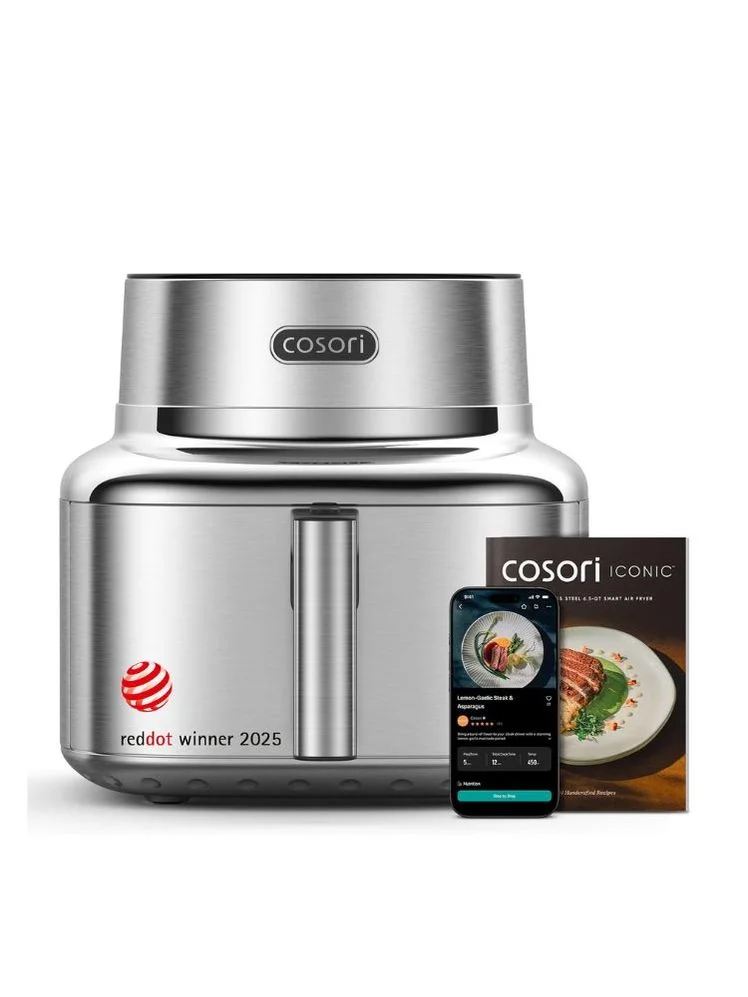
- A high-performing PFAS-free choice: Cosori Iconic Stainless Steel 6.5-Quart Smart Air Fryer
All of these air fryer styles have their pluses and minuses, and the decision as to which one to get comes down to two key things: How much counter space do you have? And are you primarily looking to crisp up frozen tater tots and meal prep some plain, simple items, or do you need your air fryer to do a lot of cooking—bake cookies, roast a chicken, toast a bagel.
The best for all varieties of air fryer needs are below.
New in this update: We tested five models in the growing category of glass air fryers, i.e., those with slide-in glass baskets or glass bowl bases with an air fryer lid. This included new reviews for air fryers from Cuisinart, Chefman, Kisimile, and Magnifique, plus retesting the Ninja Crispi against this new crop of similar products.
Three styles of air fryers, which is right for you?
Most air fryers fit into one of three categories: oven, basket, or bowl.
Oven
A countertop convection oven, or air fryer–toaster oven, combines most of the crisping power of the basket-style air fryers you know and love with the multifunctionality you get from a toaster oven or countertop oven. Generally, the “air frying” function is achieved with a perforated slide-in rack, which usually means lots of cooking surface, but the racks are usually shallow and can require careful tossing or flipping of whatever you’re cooking, depending on the dish. But air fryer ovens, like the Breville Smart Oven Pro with its 13 different cooking modes, can do a lot, making them bona fide do-it-all kitchen appliances.
Basket
Basket-style air fryers aren’t as versatile as air fryer ovens, but they’re also less expensive and take up less space. They also tend to deliver better final results on traditional air fryer stuff like crisping up small foods that require shaking (tater tots, french fries, or brussels sprouts), for which a handled basket is far easier to maneuver. Minuses are that they can be hard to clean and limited on square inches inside the basket. They’re also sometimes made of plastic or nonstick coated materials, which may not appeal to some consumers.
Bowl
Bowl air fryers offer some of the best (and worst) of both worlds and also some unique benefits. Most of these include a heat-resistant glass bowl acting as the basket. Some models operate much like basket air fryers, with the glass container sliding into the base unit, while others opt for a “lid” that sits on top and houses the air frying mechanism. The glass baskets make these very easy to clean (included crisping trays are another story), however their functionality for shaking and pausing to flip foods can be cumbersome. But many come with lids for the glass containers, letting them double as prep and storage containers too.
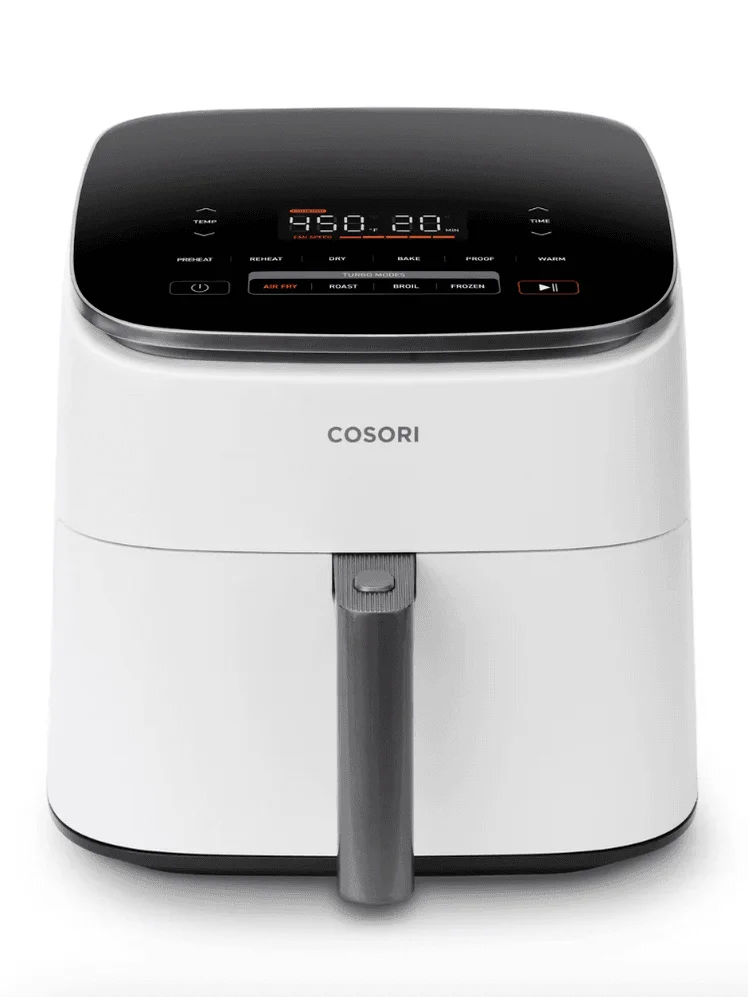
Best air fryer overall: Cosori Turboblaze 6.0-Quart Smart Air Fryer
Pros and cons
Pros:
- Moderately priced
- User-friendly interface
- Wide temperature range (90°F–450°F)
Cons:
- Food can fall between the crisper plate and bottom of the basket
Specs
Capacity: 6 qt.
Wattage: 1725
10 Cooking functions: Air Fry, Roast, Broil, Frozen, Preheat, Reheat, Dehydrate, Proof, Bake, and Keep Warm
Color: White
Weight: 11.5 lb.
Dimensions: 11.8" x 14.4" x 11.9"
Warranty: 2 years
What we love: The 6-Quart Cosori Turboblaze Smart Air Fryer impressed us in every test, producing evenly browned and crispy frozen sweet potato fries, juicy chicken breasts, and perfectly cooked brussels sprouts. It has a straightforward digital interface that allows you to easily set the time and temperature and an impressive array of preset programs (Air Fry, Roast, Broil, Frozen, Preheat, Reheat, Dehydrate, Proof, Bake, and Keep Warm).
A few things set the Turboblaze apart from the competition (including the previous longtime winner of this test, the Instant Vortex Slim). Most notably, it consistently produced the crispiest food of any air fryer we tested in record time. That may have something to do with the fact that there’s more space between the crisper plate (where the food sits) and the bottom of the basket than there is in some of the other top-performing models we’ve tried, which allows for better air circulation.
Another standout feature is its variable fan speeds, which adjust automatically depending on the cooking function. Unlike most air fryers that use this tech behind the scenes, the Turboblaze shows you the fan speed right on the display. Air Fry, for example, is one of four “turbo modes,” running the fan at full blast (speed 5), while Bake uses a gentler speed 3 to avoid disrupting delicate foods. Low-temperature settings like Dehydrate and Proof drop all the way down to speed 1.
The Cosori Turboblaze is also a real value pick. The top performer in its price range (100–150) by a wide margin, it’s powerful, versatile, quiet, lightweight, and easy to clean (the brand says both the nonstick basket and cooking tray are dishwasher-safe, though we recommend hand-washing anything with a nonstick coating).
The model we tested includes smart features, meaning you can control it remotely or use voice commands via the VeSync app. If that’s not your thing, Cosori also sells a non-smart version for about $10 less.
What we’d leave: Our gripes with this model are minor. It’s slightly annoying that you have to press a release button to pull the basket out. And while the greater amount of space between the crisper tray and basket bottom contributes to better airflow (and thus better browning), it means food is more likely to fall through while cooking.
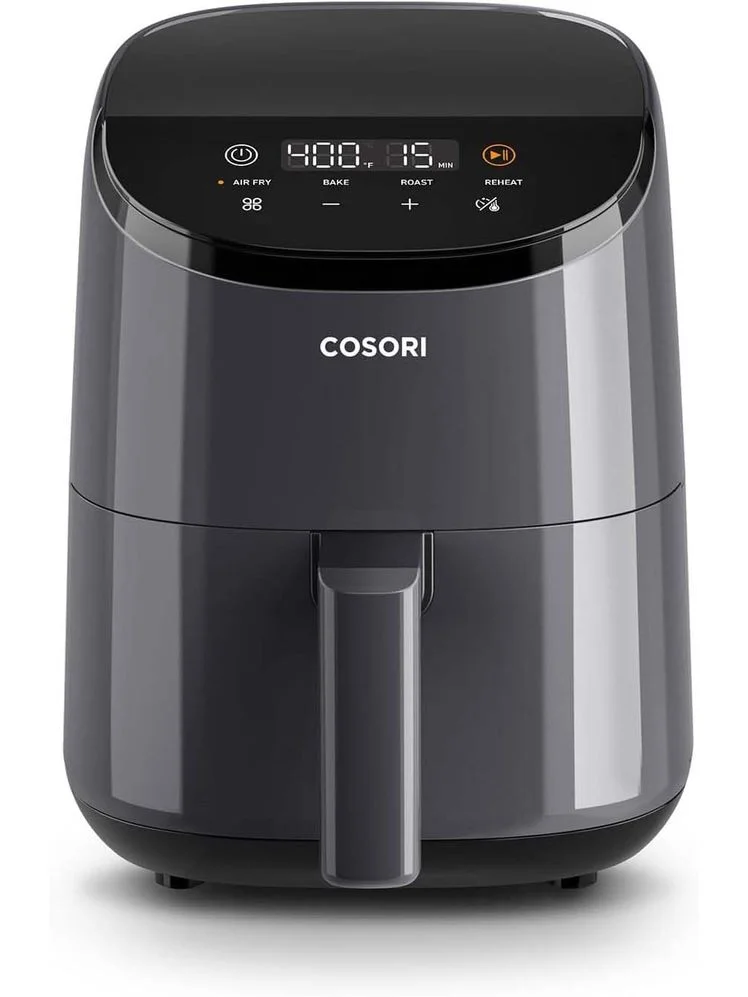
Best small air fryer: Cosori Lite 2.1-Quart Mini
Pros and cons
Pros:
- Low countertop profile
- Lightweight for easy storage
- Inexpensive
- Easy controls
Cons:
- Only room for 2 servings of food
- Few cooking functions
Specs
Capacity: 2.1-qt.
Wattage: 900
4 cooking functions: Air-Fry, Bake, Roast, Reheat
Colors: Gray, red, white, green
Weight: 4.9 lb.
Dimensions: 10.1" x 8.3" x 10.5"
Warranty: 2 years
If you’re on a tighter budget, have very little counter space to spare, or are mostly crisping up food just for yourself, consider the Cosori Lite 2.1-Quart Mini Air Fryer.
What we love: This compact air fryer did a beautiful job crisping and browning small servings of frozen tater tots and fries, sliced zucchini, and veggie burger patties (two at a time, max). Depending on where you buy, it will only costs $50–$60 (as of publish time)—not at all bad for a lightweight, quiet, digital air fryer with four easy-to-use presets (air-fry, roast, bake, and reheat). It’s easy to tuck into a cabinet and to clean. Like the Cosori Blaze, the Lite has a nonstick basket. Again, while the manual says the nonstick basket is dishwasher-safe, we always recommend hand-washing anything with a nonstick coating.
What we’d leave: Per its name, it’s quite small—don’t expect to be cooking enough food for more than two people in this thing. It also won’t remind you when it’s time to shake your food, so you’ll need to keep an eye on the timer yourself (luckily, the digital display makes this pretty easy).
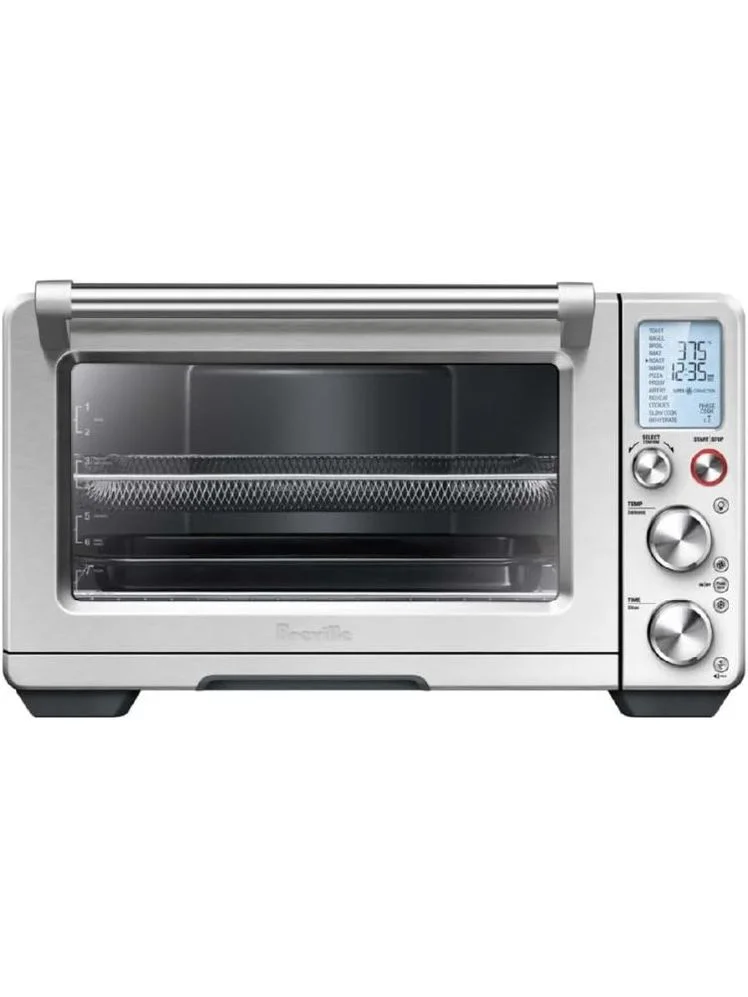
Best air fryer–toaster oven: Breville Smart Oven Pro
Pros and cons
Pros:
- Most versatile cooking functions
- Large capacity
Cons:
- Large footprint
- High price point
Specs
Capacity: 1 cubic foot
Wattage: 1800
13 Cooking functions: Toast, Bagel, Broil, Bake, Roast, Warm, Pizza, Proof, Air-Fry, Reheat, Cookies, Slow-Cook, and Dehydrate
Color: Stainless steel
Weight: 38.9 lb.
Dimensions: 21.25" x 17" x 12.75"
Warranty: 2 years
If you want an air fryer with maximum versatility and have some counter space to spare, spring for the Breville Smart Oven Air Fryer Pro. Breville makes a few different models (which can be found in the kitchens of many of our editors), but this one is the best combination of performance and value.
What we love: This midrange model has been our top pick for years now because of its versatility, build quality, intuitive design, and consistently strong performance in testing.
While it looks like an oversized toaster oven, it can air-fry, bake, broil, roast, slow-cook, and dehydrate. The air fryer function is one of 13 presets on the digital control panel, and each one employs the right combination of heating elements for perfect toast, bagels, cookies, pizza, slow-cooking, and more. (A smarter, pricier model includes Breville’s companion app for more advanced presets, including an impressive rotisserie-style chicken.)
In testing, the Smart Oven Air Fryer Pro delivered reliably great results. It excelled at foods that need to be laid in a flat, even layer across the crisper tray (think veggie burgers or salmon fillets), but also handled frozen fries, tots, and sweet potato fries well. Its interior is roomy enough to fit a quarter sheet pan or 13x9" casserole pan, which means it can effectively double your oven space (or eliminate the need to turn on your full-size oven altogether).
This model is also a favorite among BA staffers and Test Kitchen editors, as well as award-winning cookbook author Nik Sharma, who developed some of BA’s favorite air fryer recipes. “I prefer toaster-oven-style to basket-style air fryers, because they’re easier to use for more common tasks like baking, toasting bread, and roasting more efficiently,” Sharma says.
What we’d leave: As with most oven-style air fryers, it’s harder to toss or shake small foods mid-cook compared to a basket-style machine. We also found that, in general, food benefited from a higher cooking temperature (and often slightly longer cook time) relative to the basket-style winners.
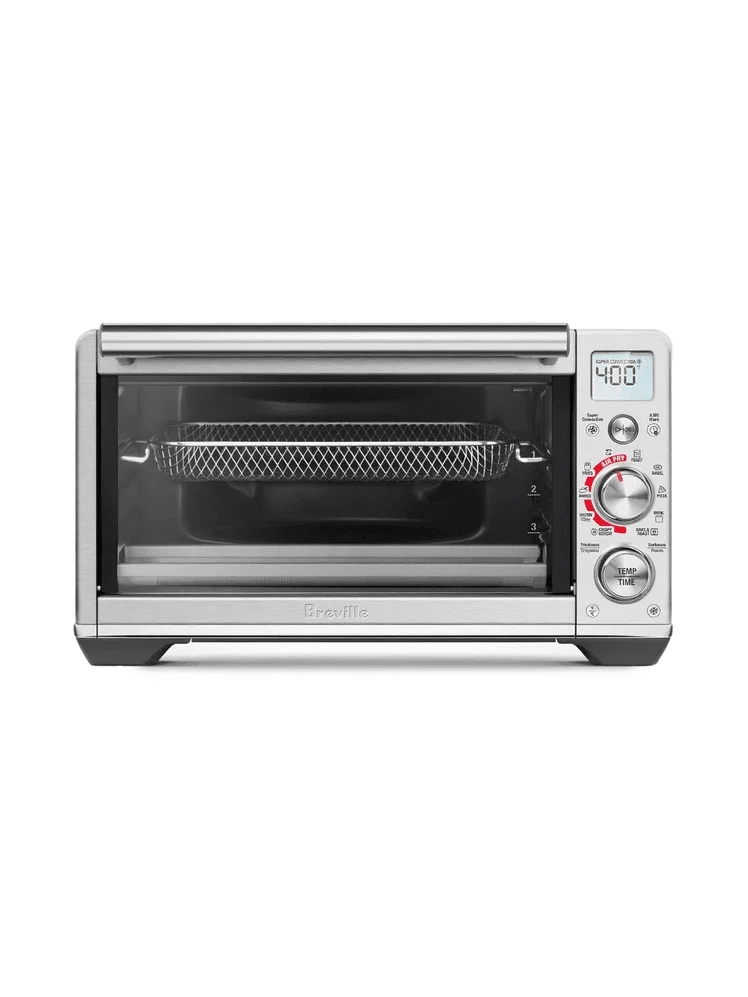
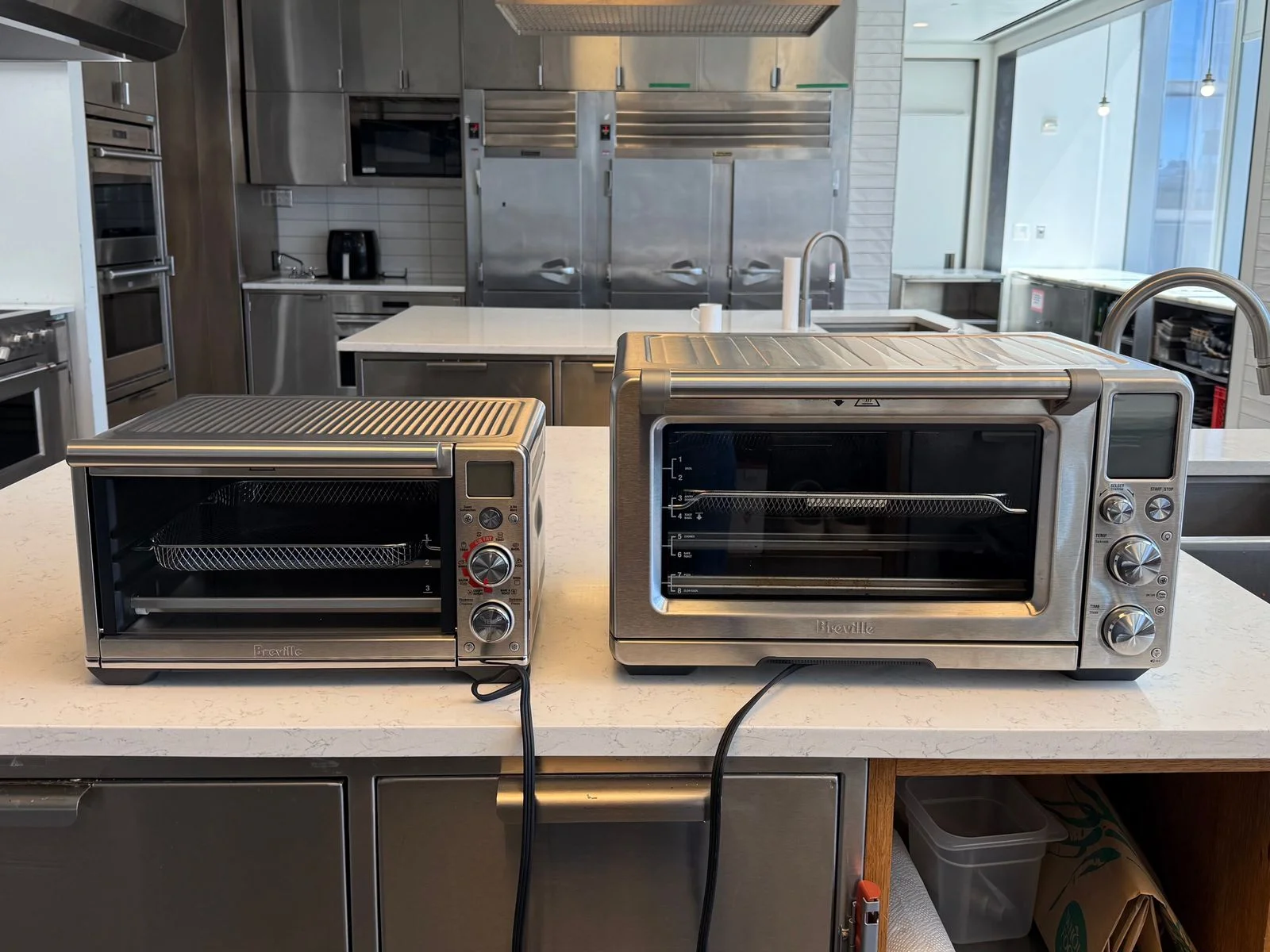
Best small oven-style air fryer: Breville Smart Oven Compact
Pros and cons
Pros:
- Versatile cooking functions
- Compact size
Cons:
- Still takes up more horizontal space than most basket-style models
- Higher price point than basket-style picks
Specs
Capacity: .5 cubic feet
Wattage: 1800
5 Cooking functions: Toast, Bagel, Broil, Pizza, Bake & Roast
5 Air-frying functions: Air-Fry, Fries, Wings, Bacon, Crispy Reheat
Color: Stainless steel
Weight: 15.8 lb.
Dimensions: 15.7" x 16.9" x 10"
Warranty: 2 years
If you like the idea of going the air fryer–toaster oven route but (1) don’t have the space for the Smart Oven Air Fryer Pro or (2) don’t want to shell out $400 in pursuit of crispiness, here’s some good news: Breville offers the Smart Oven Air Fryer Compact, which is essentially a smaller, cheaper version of our top pick.
What we love: As with most Breville products, the Smart Oven Air Fryer Compact feels thoughtfully designed, with stainless-steel finishes and a solid build. There are fewer niche modes than the Pro—no Dehydrate or Proof—but it does include four air-frying-specific presets in addition to a standard Air Fry setting.
We found using the Compact intuitive (the guide printed on the inside of the oven door helped). We also appreciated the “bit more” button, a feature borrowed from Breville’s toasters that adds a touch of extra cooking time when your fries are looking just a touch underdone.
This model performed comparably to the Smart Oven Air Fryer Pro in most of our tests, producing juicy chicken, evenly browned cubes of tofu, and crispy veggies. We still prefer the larger model for its versatility and additional functionality, but this little oven would make a worthy addition to any smaller kitchen.
What we’d leave: While the Compact did well in most tests, it struggled a bit with frozen sweet potato fries. This largely came down to overcrowding due to the smaller capacity: While we tried to fit an entire bag’s worth on a single tray, the unevenness with which the fries browned is a good example of the fact that, unlike a basket fryer, countertop oven-style air fryers are best used to cook things in a single layer.
As mentioned, there’s a guide to oven inserts and placement on the inside of the oven’s door, but this is easy to miss, and these suggestions did not appear in full in the manual. Because of this, one tester accidentally cooked chicken with no tray underneath the wire basket to catch the drippings, which resulted in a smoking-hot mess.
It’s also worth noting that one of the major benefits of opting for an oven-style air fryer tends to be capacity, but the Compact wasn’t able to fit more food than our top basket-style pick.
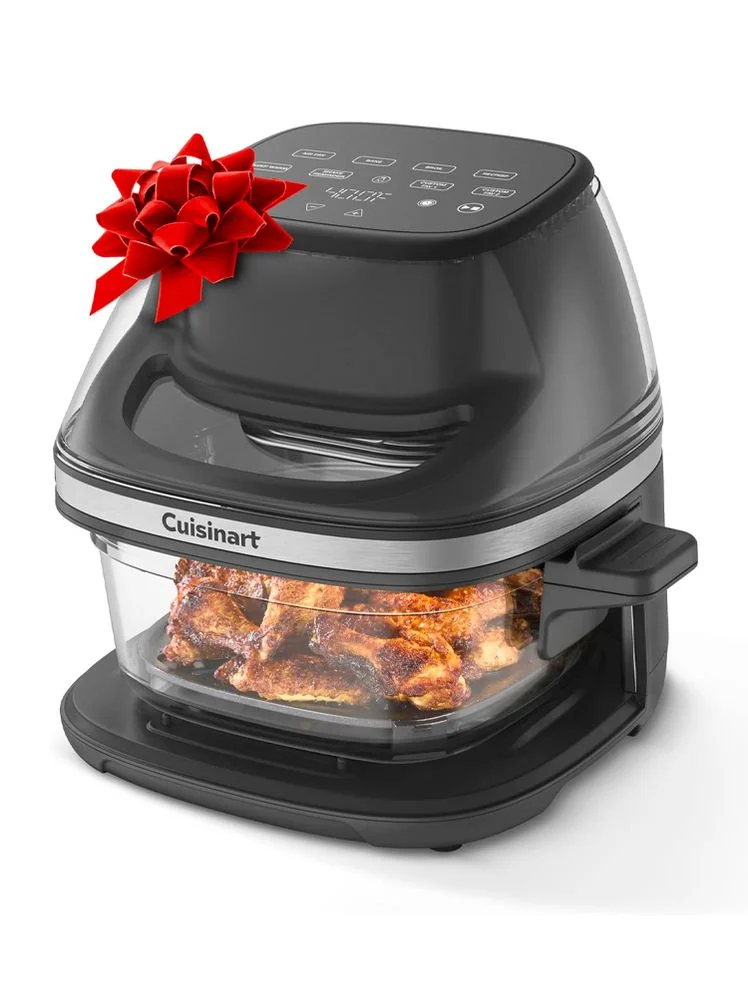
Best glass air fryer: Cuisinart ClearView 4-quart Glass Basket Air Fryer
Pros and cons
Pros:
- Glass bowl with basket-style functionality
- Viewing window and light
Cons:
- Large footprint
- Glass basket not oven- or microwave-safe
Specs
Capacity: 4 qt.
Wattage: 1600
5 Cooking functions: Air Fry, Bake, Broil, Recrisp, Keep Warm, plus custom settings
Colors: Black, Toasted Oat, Sage, Tahini
Weight: 12.75 lb.
Dimensions: 13.75" W x 12.75" D x 11.25" H
Warranty: 3 years
New on the market in 2026, Cuisinart’s ClearView series of air fryers truly delivers on its name with the introduction of a glass basket model that also sports a viewing window on the top of the unit (the line also features a larger, 9-qt. non-glass model). Unlike other glass air fryers we tried, this one operates more like the basket-style most people expect when they think of an air fryer.
What we love: The ClearView got high marks across the board in our tests comparing glass air fryers head-to-head, almost always offering up the winning results. The controls are easy to navigate, and the functions are intuitive with beeps to remind you to flip or shake your food when your cook is halfway through. In addition to the usual Air Fry, Bake, and Reheat functions, Cuisinart’s also offers a Keep Warm. Plus, there are two programmable custom presets if you’re cooking the same foods frequently.
The crisper plate is nonstick, coated in PFAS-free ceramic, making it a breeze to clean with a little soap and water (or just throw it in the dishwasher). The glass basket is also dishwasher-safe. The ClearView doesn’t have any kind of mesh or grate covering the heating mechanism. We’ll continue to see how this fares over time, but in the meantime it’s nice not worrying about another greasy, perforated plate to clean. Lastly, the ClearView 4-Quart Glass Basket Air Fryer also comes in four colors—Black, Toasted Oat, Sage, and Tahini—and, as with all countertop appliances, it’s nice to have some kind of choice behind black plastic and stainless steel.
What we’d leave: The cord wrap post noticeably sticks out from the back of the unit. While this is probably great for airflow safety, it adds inches to a machine that’s also tall. And unlike some of the other glass air fryers we tried, Cuisinart’s bowl is oven or microwave safe. Granted, the point of the bowl is to air-fry, but if you’re using to carry your lunch into the office after cooking the night before, reheating is a little trickier.
A high-performing, PFAS-free choice: Cosori Iconic Stainless Steel 6.5-Quart
Pros and cons
Pros:
- Ceramic nonstick basket
- Sleek digital interface
Cons:
- Bulky
- On the pricey side
Specs
Capacity: 6.5 qt.
Wattage: 1725
6 Cooking functions: Air Fry, Roast, Bake, Dehydrate, Proof, and Reheat
Color: Stainless steel
Weight: 14.1 lb.
Dimensions: 11.8" x 11.8" x 11.6"
Warranty: 5-year limited
We won’t go down the PFAS rabbit hole and get deep into the concept of “nontoxic” cookware right here and now (we've got other articles for that), but given the way the concept has come front and center we know some people want an air fryer with a PFAS-free nonstick basket—and for that, we recommend the Cosori Iconic.
What we love: It has similar features and produces similar results to our top pick, the Cosori TurboBlaze, churning out crispy-skinned salmon and beautifully browned Brussels. Like the TurboBlaze, the Iconic allows you to choose between five different fan speeds, which means it's equally adept at turning delicate kale into crispy chips without blowing them around the basket as it is cooking hefty bone-in chicken breasts to bronzed perfection.
And for those looking to eliminate PFAS from every inch of their kitchen, it has both a PFAS-free ceramic nonstick-coated basket and crisper plate.
What we’d leave: Aesthetically, it may not be for everyone as this stainless-steel air fryer looks a bit spaceship-like. But the real downside is the price, which is practically double that of the TurboBlaze.
In the long run: The Cosori Iconic has seamlessly fit into the life of BA’s head of video, Dan Siegel. The speed is what won him over: “I shave 25% or more off any package-recommended cooking time and achieve perfect browning and crisping on every cook. The nonstick surfaces of both the basket and the included rack are remarkably easy to clean, making this my go-to appliance. My toaster oven probably misses me.” He mostly uses it for his two kids, occasionally scaling up to cook chicken breasts for his family of four, which takes two batches. (“It’s not huge.”) Despite the mirror-like stainless-steel finish, upkeep has been simple: “I haven't had any issues; I really only touch the top and the basket.” And then there’s the look. "It looks grown-up, like an actual appliance and not a big plastic toy without looking industrial. The MacBook of air fryers."
How we tested air fryers
We have spent hours and hours over the past few years researching, testing, and retesting popular air fryers from top-name brands, including Breville, Cuisinart, Ninja, Philips, and Cosori. Here's how we put each appliance to the test:
- Skin-on proteins: We cooked salmon fillets and chicken breasts or thighs in each air fryer, noting how crispy each piece became, how juicy it stayed, and how evenly it cooked.
- Fresh veggies: We cooked a batch of Brussels sprouts to test how each fryer handled moisture. We looked for crisp edges and tender—but not mushy—interiors.
- Marinated tofu: We crisped up cubes of marinated tofu to see if the air fryers could deliver crunchy, golden brown nuggets with soft interiors—and no stickage in the process.
- Frozen foods: We cooked an entire package of frozen sweet potato fries to see how each model handled cooking food from frozen (and the requisite moisture doing so creates).
What makes a good air fryer?
When evaluating each model, we looked for a few key qualities:
- Crispiness in output: A crucial task for any air fryer. Can it crisp food better than your average wall oven?
- Even cooking: Even with mid-cook shaking or stirring, we wanted consistently browned, crunchy results—we didn’t want to see any fries that are super crunchy on one end and raw on the other.
- Ease of use: Regardless of how many presets a model offers, setting the time and temperature should be simple and intuitive. Was it a simple dial and a few buttons, or did it feature a confusing and hard-to-navigate interface?
- Functional design: Square and rectangular baskets offer more surface area than round ones. We also preferred fewer interlocking pieces, which makes the appliance easier to clean.
- Easy cleaning: We took these machines apart and scrubbed them after we tested. In general, the fewer pieces there are, the easier it is to clean and (nontoxic) nonstick coatings got some bonus points.
- Mobility and storage: We looked for options that work for those who want something light and cabinet-friendly for occasional use, and those happy to keep a larger, more versatile machine on the counter for occasional use, and those happy to keep a larger, more versatile machine on the counter.
Others I liked
Instant Pot 4-Quart Mini Air Fryer
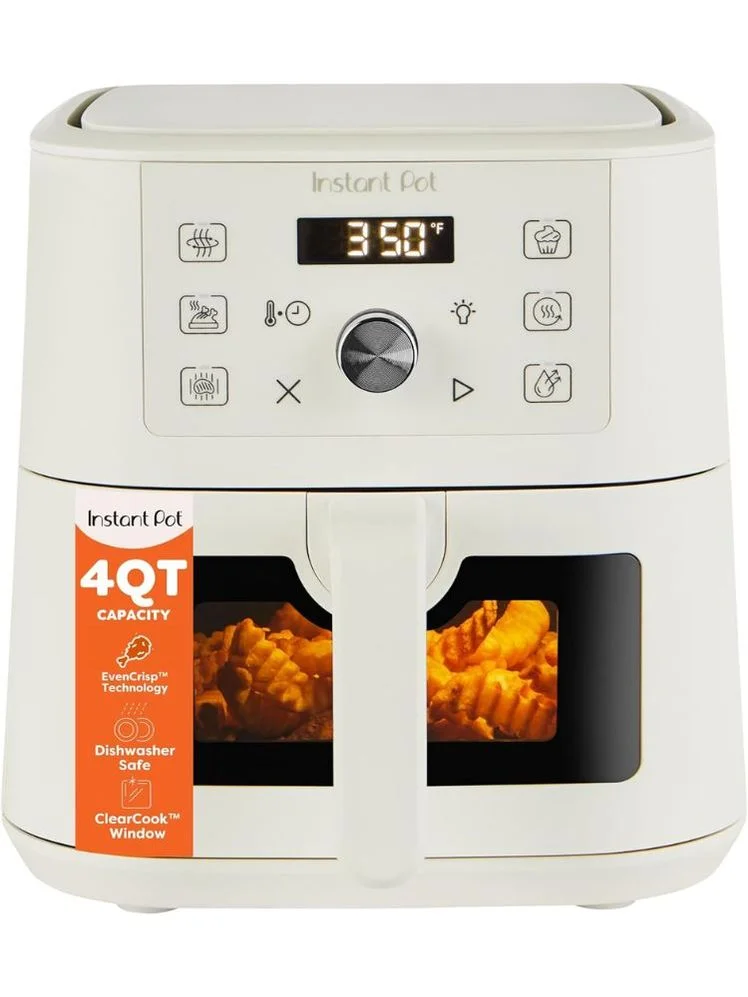
This model from Instant Pot is a great option if a full-size (6-qt. or more) air fryer feels too big for your space or lifestyle, but our winning mini model (2-qt. limit) is too small. There’s a lot to love here, including the intuitive controls and presets, the viewing window and built-in light, and the ceramic nonstick interior coating. In testing, we found it did a decent job crisping everything we threw at it, though its performance didn’t quite match the winning Cosori Turboblaze.
Instant Vortex Slim 6-Quart Air Fryer
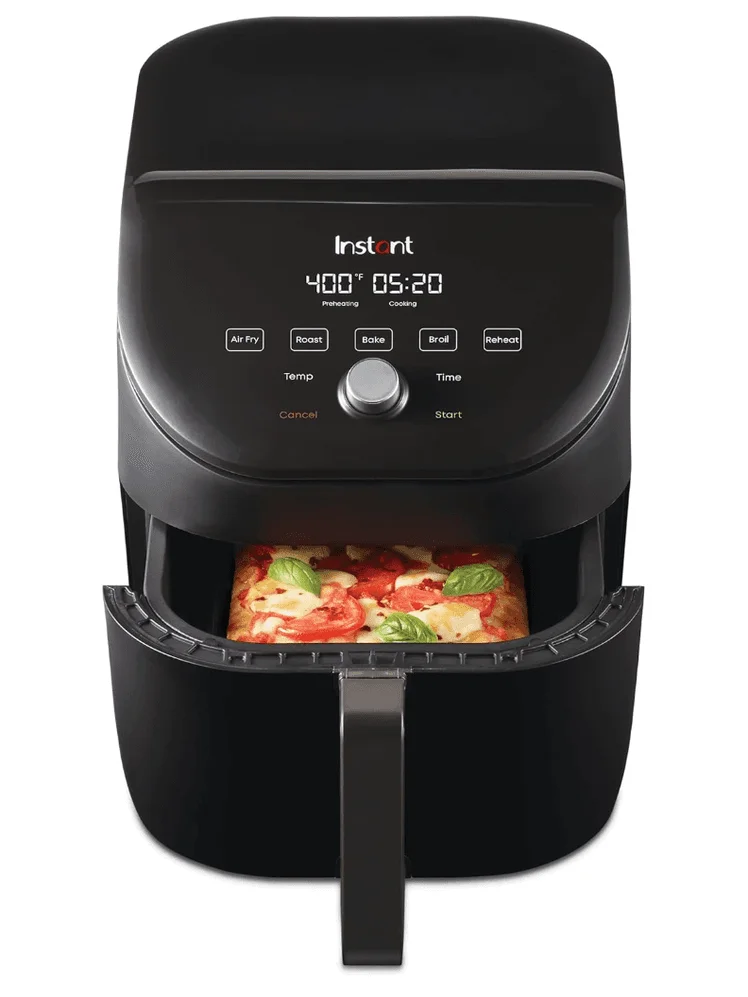
This model from Instant was a previous top pick, and we still think it’s an excellent air fryer. Its design, although compact, offers a significantly larger cooking surface area than comparably sized air fryers thanks to the shape of its basket. In practice, this meant our tester was able to fit an entire extra veggie burger patty (six total) compared to models of a similar size and generally cook more food in each batch without sacrificing any of the airflow that makes air-fried food so crispy.
Instant Vortex Plus Clearcook
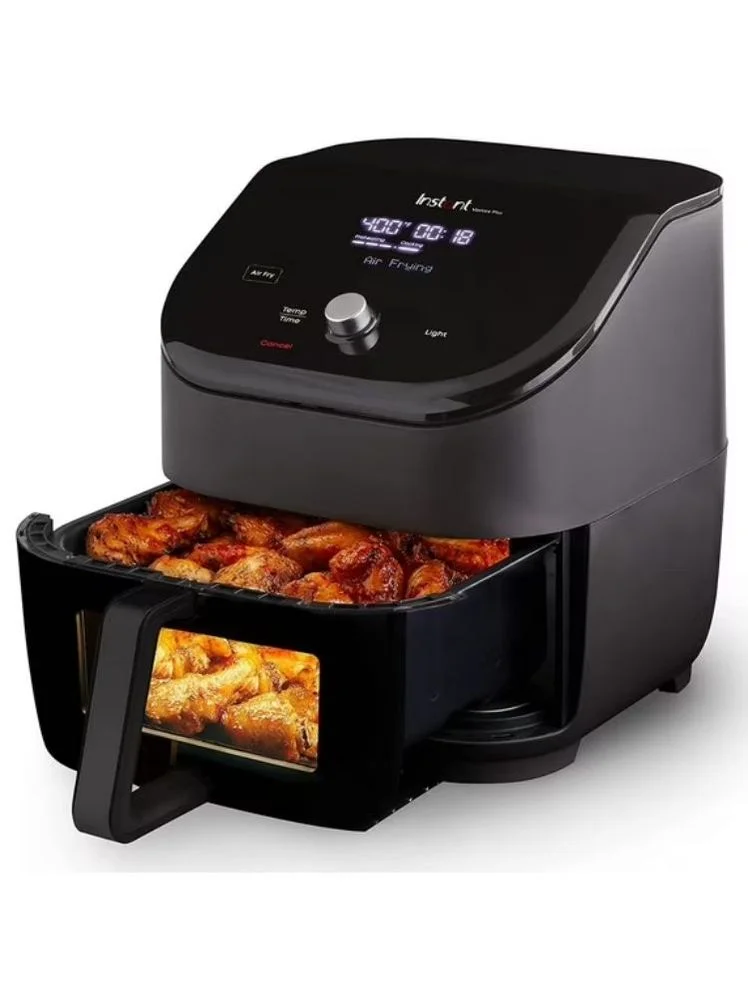
If a basket-style air fryer is what you’re after and you like the idea of being able to monitor what you’re cooking, the Instant Pot Vortex Plus ClearCook is definitely worth considering. This model performed nearly identically to our old top pick, the Instant Vortex Slim (probably because it’s a very similar build). The major difference—besides the ClearCook’s dimensions—is that it has a cooking window located at the front of its basket, plus a button that switches on an interior light, sort of like a traditional oven. This makes tracking the progress of your tots, fries, or chicken wings possible without removing the basket and disrupting the cooking process. Considering that providing a certain level of brownness is one of the chief concerns in air fryer cooking, this really comes in handy. A few more bonus points for the ClearCook: It adds Dehydrate to its list of functions and can hold temperatures as low as 95°F (the low end of the Vortex Slim’s range is 120°F). The ClearCook also happens to be $30 cheaper than the Slim at full price. On the downside, the square shape of the ClearCook’s basket fits one less veggie burger patty than more elongated baskets. It’s also a bit bulky.
Typhur Dome 2
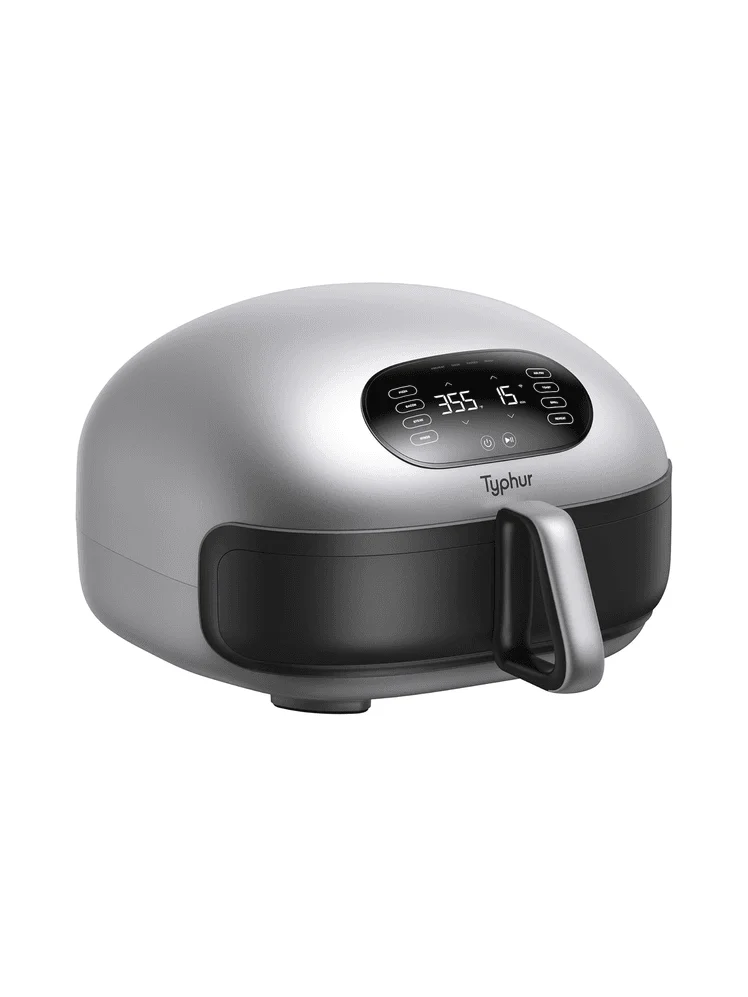
The Typhur Dome 2 is notably spacious compared to other basket-style fryers, with 139.5 square inches of cooking surface that fits a 12" pizza, 20 chicken wings, or 11 large chicken thighs per batch, and a digital panel with 15 presets plus a companion app offering more settings, self-cleaning, and one-touch recipes. We used to recommend the original Typhur Dome as a top pick for extra-large capacity, but after testing the Dome 2, which replaced it, we felt its performance didn’t quite merit a spot on our top picks: When filled to capacity, it took much longer to properly cook and crisp food than most other basket air fryers, and 11 bone-in chicken thighs took upward of 45 minutes to get truly golden, a major red flag given that cutting cooking time is a big reason to choose an air fryer over the oven. That said, the Dome 2 cooks food evenly and does eventually get very crisp, so if you’re feeding a large family and have counter space to spare, it may still be worth the investment.
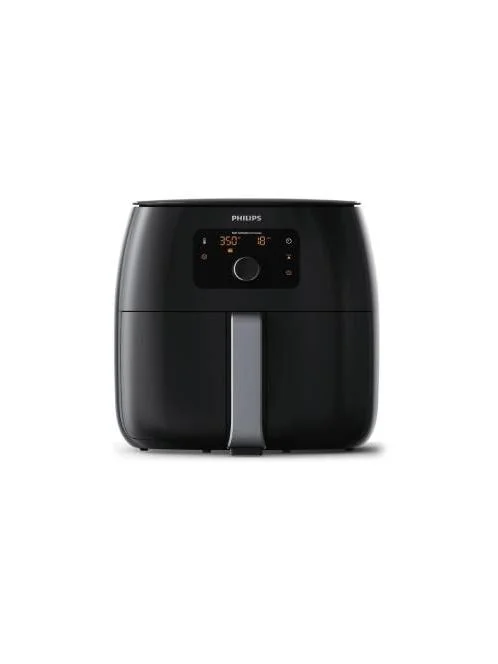
The Philips almost took a top spot—almost. It’s got a generous capacity, the control panel is easy to navigate, and it performs well with minimal user intervention. In other words, you won’t have to do a lot of shaking or stirring to get crispy fries from the Philips. This model did have a smaller yet heavier basket, and it’s loud and harder to clean due to a bunch of interlocking parts. It’s a good air fryer, but with its higher price tag, we feel like there are better deals on this list.
Philips 3000 Series Single Basket Air Fryer
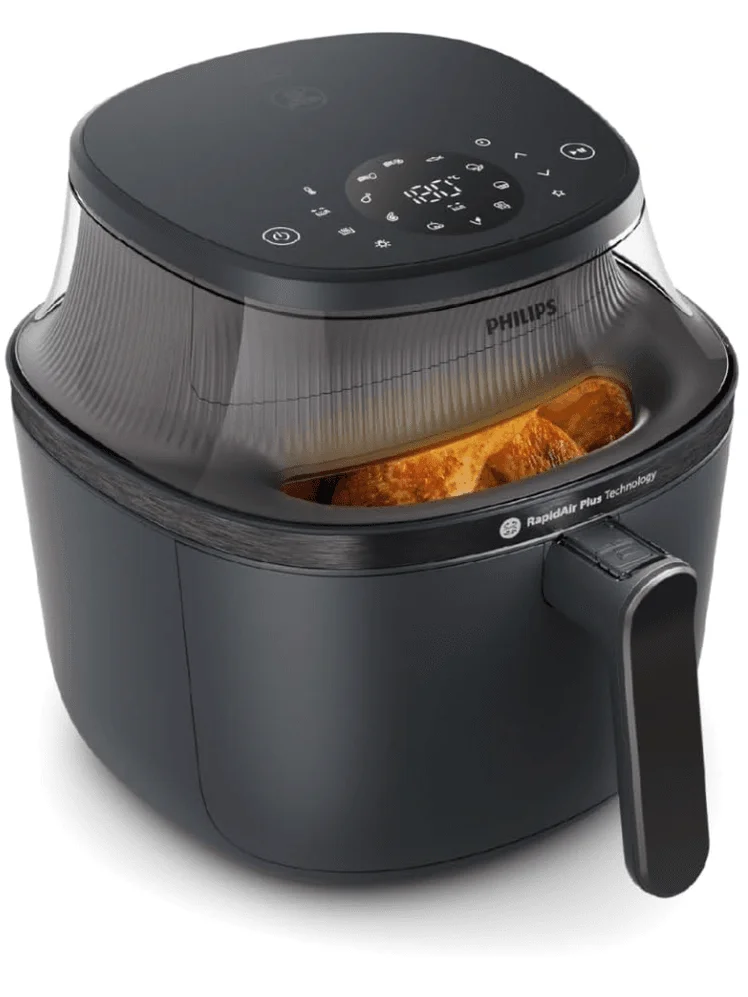
This newer model from Philips has a lot going for it: sleek touchscreen interface, helpful viewing window, and a whopping 16 settings. It did very well in our testing, producing crispy tots, tofu, and fries, but we preferred the design and the interface of the Cosori and Instant models. If you’re looking for an air fryer with a window feature, we’d recommend going with the Instant ClearCook (slightly cheaper at the time of writing) unless you find this model at a discount.
Dreo ChefMaker Combi Fryer
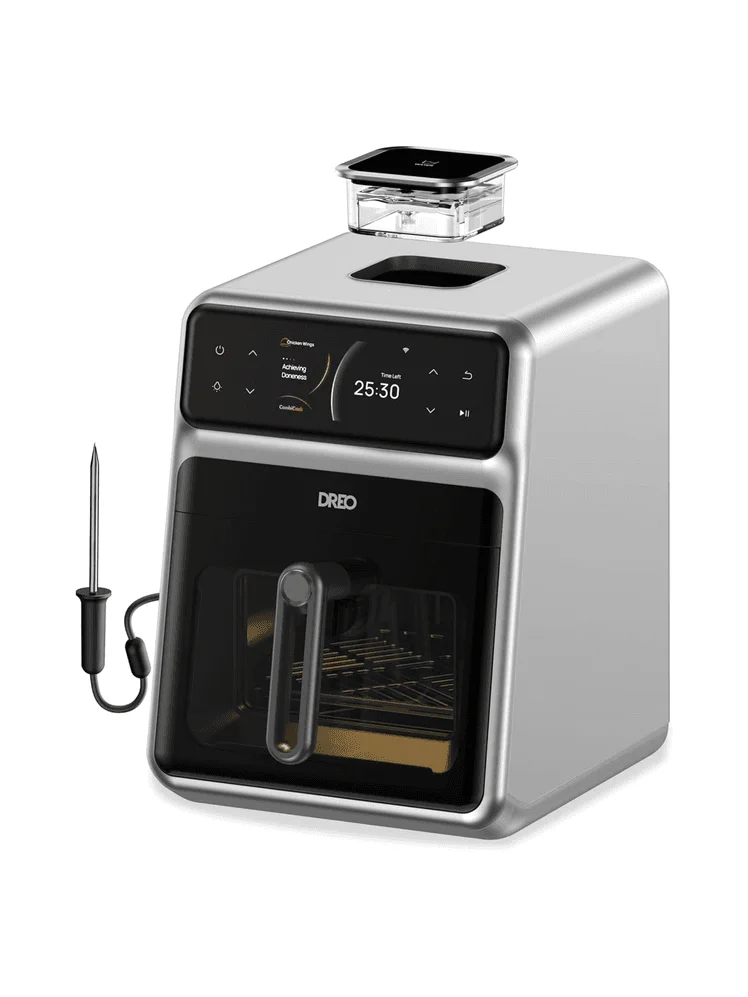
The Dreo ChefMaker isn't just an air fryer—it's also got probe cooking capabilities and app compatibility that make cooking proteins pretty effortless, and is a personal favorite of senior editor Olivia Tarantino. For the purposes of this article, though, we mainly tested its air frying abilities. We found that while the Dreo performed well, the winning TurboBlaze produced crispier, more evenly-cooked results all while ringing in at a third of the price. That said, if the probe cooking feature intrigues you, this fryer might be worth a try.
Our Place Wonder Oven Pro
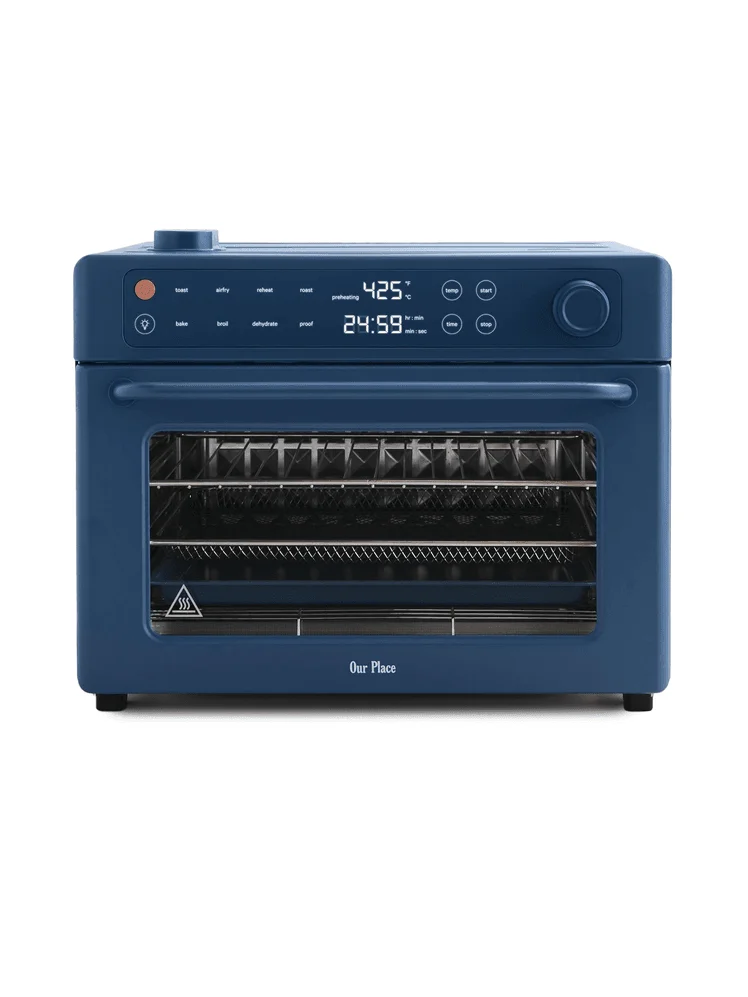
Our Place partnered with James Beard Award–winning chef and cookbook author J. Kenji López-Alt on this updated version of the Wonder Oven, which features eight cooking functions, a touchscreen interface, and a roomy three-tier 30-liter capacity. Like all of Our Place's products, this little oven is an aesthete’s dream—but looks aside, it impressed us. It’s incredibly powerful, able to crisp brussels sprouts, tofu, and fries up to twice as fast as the winning Breville. It produced tender salmon with potato-chip-like skin in just seven minutes. Despite its smaller footprint, it’s large enough to fit a quarter-sheet pan, making it a good option if you want to save a few inches of counter space.
All that said, while the Wonder Oven Pro is generally well-designed, a few features were annoying to use. The touchscreen isn’t the most responsive. But the bigger issue we had was with the preheating cycle. Preheating this oven to 400°F took 8–9 minutes from cold, which is already slower than the Breville’s 4–5. But more importantly, the Breville (like most regular ovens) takes less time to preheat when it’s already at temp. The Wonder Oven Pro, on the other hand, seemed to kick off a whole new several-minutes-long preheat cycle even when it had just been heated, only after which the timer would start.
Cuisinart Air Fryer Oven 6-Qt
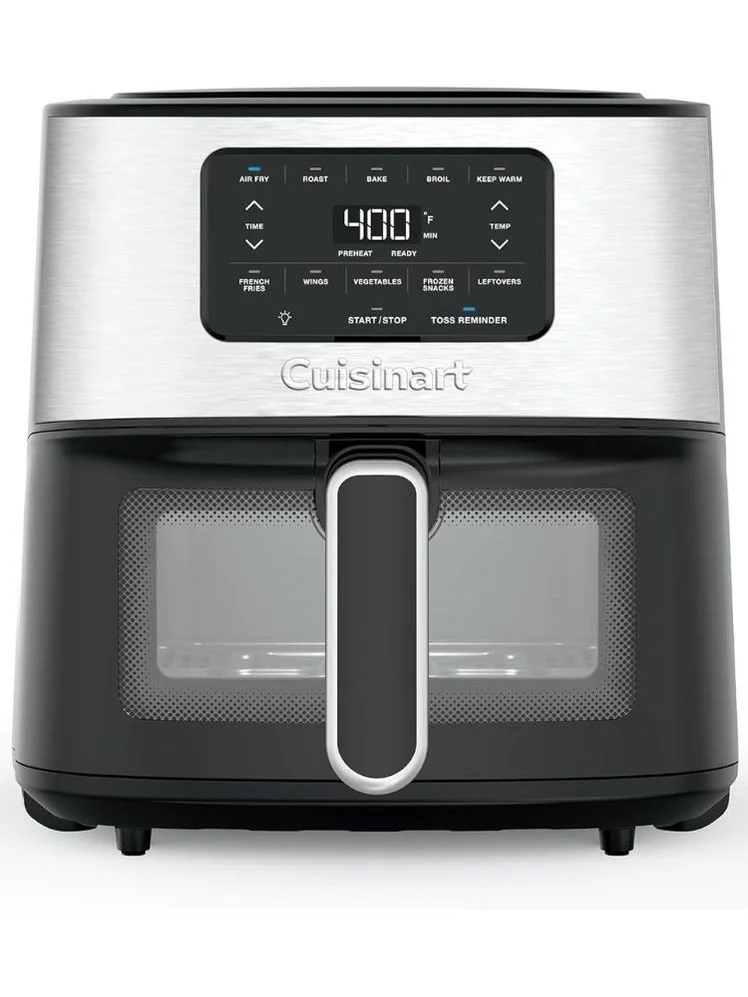
The Cuisinart was easy to use, didn’t whirr too loudly, included a nice preheat feature, and was about the same price. We also really liked the viewing window you could use to check the progress of your food. However, its deeper square-shaped basket has less surface area than something like the Instant Vortex Slim’s rectangular one, which limits its capacity.
Ninja DoubleStack XL 2-Basket Air Fryer
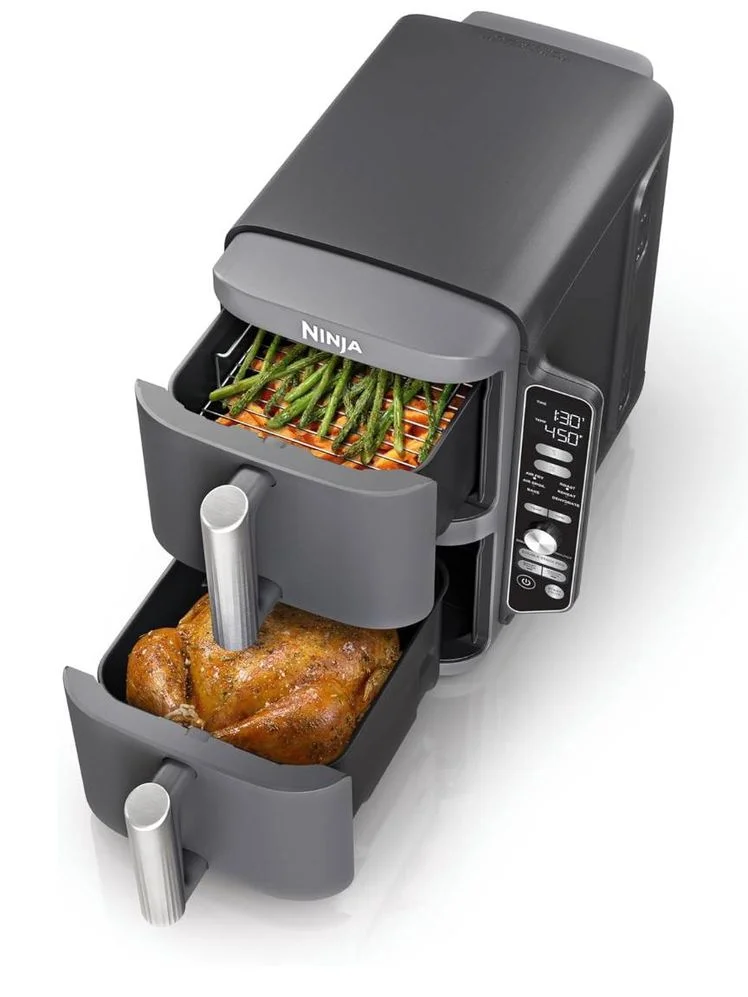
The DoubleStack takes the idea of a dual-basket air fryer to a whole new level—literally. Like the Vortex Slim, the DoubleStack’s design prioritizes using vertical space. It’s skinny with the baskets stacked on top of each other instead of side by side like most other dual models. This makes it narrow and tall instead of wide, but not so tall that you can’t nestle it under your cabinets. Despite its space-saving design, you don’t lose out on actual cooking space. The baskets are big enough to fit a chicken, and the wire racks in each mean you can really maximize how much you’re cooking. (Though you do need to remain mindful of not overloading it with food, otherwise you’ll block the airflow and mess up the whole air-frying process.) You can also program the baskets separately and utilize the machine’s Smart Finish feature—which delays the start of the basket with the shorter cook—to have a whole meal ready at the same time. The one thing we didn’t like was the somewhat confusing interface.
Kisimile AeroLucen 5-quart Glass Air Fryer
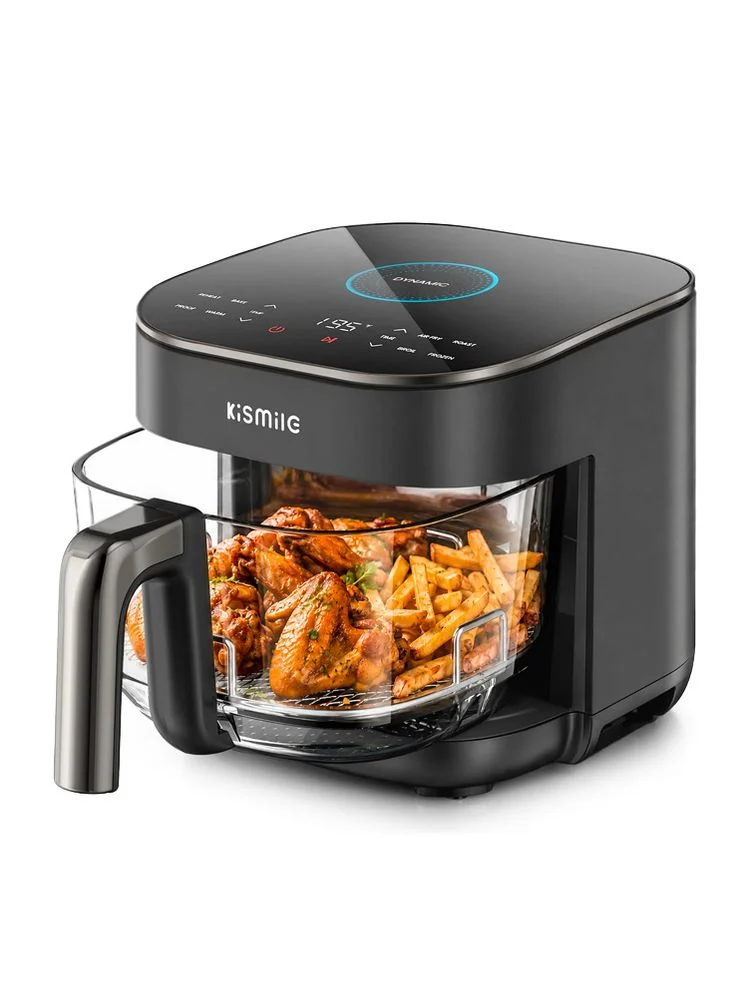
Like the Cuisinart ClearView we recommend above, this glass air fryer operates like a traditional basket air fryer, in fact even more so as it features a front-mounted basket handle with slide-in operation. It’s a sleek-looking machine with a glossy top that illuminates when powered on with all of your touch-surface buttons. And we like that’s is relatively compact at just over 9.5" tall, making it great for in-cabinet storage. In the glass category, it performed nearly as well as the Cuisinart across the board with just a few cases of less even results, but we’re really nitpicking. What we didn’t like was the mesh-style crisping plate, which is tedious to clean and sits awkwardly on some jutting posts inside the basket, (though its design does offer a high and low position for maximizing space or airflow). That mesh is repeated on the underside of the heating element, something we don’t look forward to cleaning after a few dozen oil-evaporating cooking cycles. The internal light is intended to help you see what you’re cooking, but it glows red, which isn’t so helpful when you’re trying to keep an eye on browning.
Chefman Crisp n’ Go
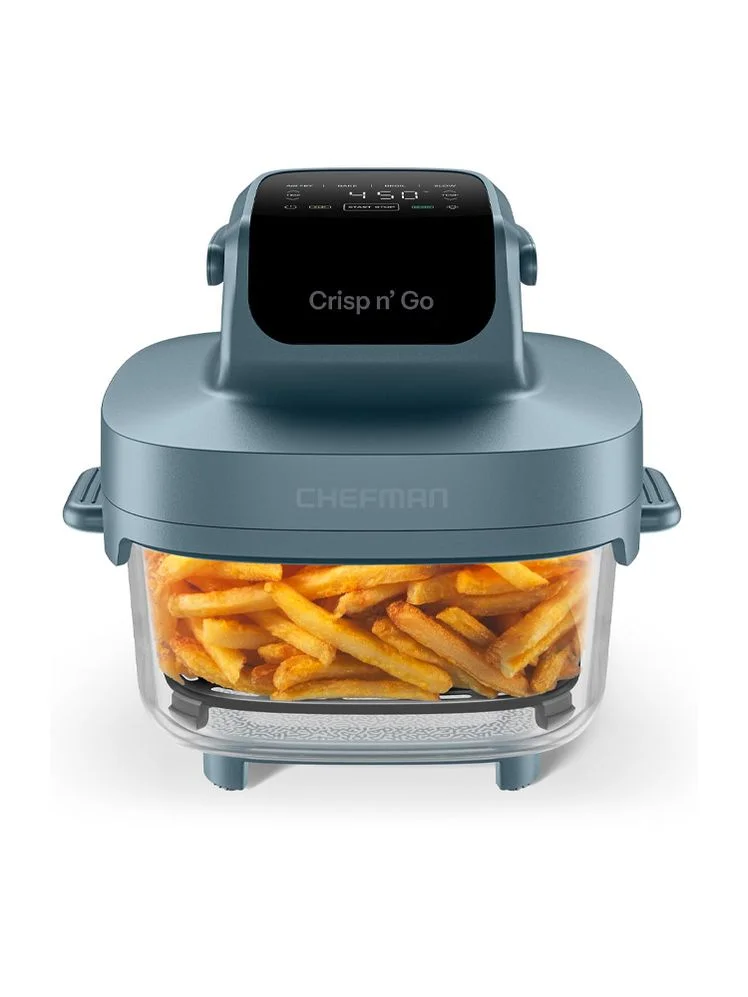
Of the lid-style glass bowl air fryers we tested, this one was the easiest to maneuver with a fold-away handle that makes removing the top easy for flipping or shaking in the middle of cooking. With fine-tunable controls, it nailed crunchy skin on chicken thighs and crispy brussels sprouts with tender centers. More delicate dishes like salmon didn’t get where we wanted on the first try, and tofu cubes required more time than the recipe allotted to get anywhere near crispy enough. It fell short, as a lot of the glass bowl fryers did, on frozen fries, yielding uneven results and underdone portions when using the settings suggested on the back of the bag. We wish the “flip” alert was more than just a light, and it’s a little odd that the “Dehydrate” setting is listed as a bonus because you have to long-press another button to use it. The attached feet also mean the glass bowl can’t be put in the oven or microwave, but it is dishwasher-safe and comes with a lid. Plus, the whole fryer and basket setup is designed to nest inside itself for storage. And of this style of meal-prep-friendly air fryers, it’s the best version.
Air fryers we don’t recommend
This Instant Pot air fryer model is if you need something with a smaller capacity. The rectangular shape of its basket made it easy to fit plenty of food inside. It is sleek and has a short profile, which are nice features too. The Vortex Slim just offered better performance.
This is Ninja's basic basket air fryer. It’s lightweight and simple to use, and it does a nice job crisping up fries. The round shape of its basket, though, makes it less versatile than other models on this list. If you’re trying to cook raw proteins or a tray of vegetables, you give away a lot of space with a round basket.
While the Dash looks cute with its retro silhouette and poppy colors, it just didn’t perform that well. Sweet potato fries came out soggy and greasy. Tofu cubes got crisped on one side but were raw on the other, and the round basket could only fit one veggie burger. The two dials, controlling time and temperature, also prevented us from getting more specific in the cook settings.
This oven-style air fryer from Panasonic performed well in our testing, but we found it frustrating to use for a few reasons. It has 12 different functions, but they come with very little on the display as to what each of these functions truly means. The Air Fry mode only allowed us to select temperatures between 410℉–445℉, which seemed quite high for certain foods. We also disliked the automatic preheating period that we couldn’t bypass even if the oven was already hot (this was particularly annoying when we just wanted to tack on an extra few minutes after finishing a cooking cycle). If you want to do that, you have to take the extra step of once again pressing the start button after the preheating process in order to start the timed cook cycle.
Like all of DTC darling Our Place’s products, the original Wonder Oven is cute. Unfortunately, it failed to impress us enough to earn a recommendation here. While it did fine at cooking tater tots and french fries, it produced unevenly browned, ultra mushy zucchini and tofu that never quite got the crisp exterior we were looking for. The analog controls are aesthetically pleasing, but make selecting an exact temperature impossible (and knowing when the unit is at temperature impossible too). It did, however, make a shockingly good fillet of crispy-skinned salmon.
Rather than a typical basket system, the Crispi consists of a glass container and a PowerPod that sits on top. The idea is that you can store your food directly in the glass containers, and Crispi sets include as many as three basket sizes (with more available). While most food did get crisp in the Crispi (you’d hope so with a name like that!), it took longer to do so than in a standard basket air fryer, and we found that food cooked somewhat unevenly. We tested this unit twice, the second time head-to-head with other glass air fryers, and our biggest gripe remains that there’s no precise temperature control—instead, you must choose between four preset modes (Max Crisp, Bake, Air Fry, and Recrisp). We thought that lack of precision made this model less versatile, and remembering which mode to use for which temperature number recommended on the bag of frozen fries or other foods wasn’t very user-friendly.
The Typhur Sync has lots of bells and whistles, like a wireless probe thermometer (with a built-in charging port), app compatibility, a PFAS-free basket, and nine total programs (including the three found only in the app). In testing, though, it failed to produce as impressive results as the winning Cosori. The fries browned, but many remained soggy, the salmon skin failed to crisp, and the Brussels sprouts didn’t quite get as golden as we’d have liked. While some of this might be solved by tinkering with time and temperature, at $160, we just didn’t feel this air fryer was worth the splurge.
In its defense, Magnifique’s Glass Air Fryer has some thoughtful features: two sizes of glass baskets (4.5-qt. and 2.5-qt.), each with lids, and a silicone base that’s easy to remove for cleaning and oven or microwave cooking (something Cuisinart and Ninja can’t match). It’s also the only glass air fryer we tested in this round that could possibly hold a small pizza with an 8.5" diameter crisper plate. However, there are more than a few aspects that weren’t as user-friendly. The stainless-steel crisper plate (no nonstick coating whatsoever) was the most difficult to clean by far, not only because of that lack of coating but because of the perforation pattern as well. The instructions specifically say don’t use scouring pads, but a gentle scrub with a plastic pad was the only way we could remove all the residue. There’s no reminder to flip or shake your food halfway through, a pretty standard-issue beep on many other units, and when you do take the lid off, you have to actually hit Start again to keep going, something other fryers do automatically. Results, especially with frozen foods like fries, were uneven, and fine-tuning is near impossible as its interface only allows for four preset cooking modes with no customization. If you’re following a recipe, you’ll have to remember which mode gets to which general temperature range and hope for the best.
FAQ
What is an air fryer? Is it just a convection oven?
An air fryer is a countertop oven that uses hot air, circulated by a fan, to give foods crisper textures than you can achieve in a regular oven or toaster oven. What makes an air fryer a “fryer” is a built-in convection fan that blows the hot air around the food to crisp it up. It’s the combination of heat and moving air that produces the kind of crispy exterior you’d otherwise get from deep-frying or pan-frying. But unlike a deep fryer, an air fryer requires far less oil to achieve the desired effect—and it doesn’t leave your house smelling like a grease trap for days or weeks. So, technically speaking, yes, air fryers are just small convection ovens, but the most classic form of air fryer isn’t usually oven-shaped, rather more like egg or block with a slide-out basket on the front.
Whether you’re a purist and only consider products that contain baskets to be true air fryers, or you find the term air fryer to be stupid marketing jargon for a convection oven is up to you to decide. For the purposes of this review, we’ve included both toaster ovens that contain convection or “air fryer” settings and basket or bowl air fryers.
What accessories should I buy for my air fryer?
There are a few extras you can buy to optimize your frying experience—things like an olive oil sprayer (so you can crisp without spilling oil on the heating element), parchment paper liners, and an instant read thermometer. For more of our favorite air fryer accessories, head right this way.
Get to know your reviewer
Alaina Chou: I’ve been testing air fryers and other small appliances for Bon Appétit and Epicurious since 2023. In that time, I’ve cooked countless batches of salmon, brussels sprouts, and frozen fries in pursuit of an air fryer that delivers on the lofty promise of deep-fryer-level crispiness without the need for a vat of hot oil. And I’ve blown out the power in the Test Kitchen numerous times in the process (sorry, Test Kitchen editors).