The Truth and Fiction About the World’s Fanciest Cookware

Copper cookware has a way of pulling focus. It’s expensive, it’s eye-catching, and its associations with French cuisine and the origins of haute gastronomy make it a talisman of prestige. Revisit some iconic cinematic depictions of kitchens— Babette’s Feast (1987), The Taste of Things (2023), and even Ratatouille (2007) come to mind—and you’ll find copper there, gleaming alluringly among the set dressing.
But pans don’t become standard in a restaurant’s kitchen just because they look good (most people would never see them in the back of the house anyway). Copper is an efficient conductor of thermal energy compared to other metals typically used in cookware. Cookware made with copper is thus known for its even heating and responsiveness to changes in temperature, capable of accommodating subtle adjustments for finicky things like sauces and custards.
At least, that’s what cookware manufacturers would like you to believe.
The reality is that not all copper cookware is as good as it claims to be. The mere presence of copper in a pan doesn’t guarantee that responsive and even-cooking performance. But without side by side testing, it’s hard to tell when copper is there just for show, and when it's actually doing the work.
Jump to the only copper pan I tested that actually gave that essential “copper” performance
Seeing as all copper cookware is expensive, which copper pans are really, actually worth it?
The answer depends on what you want it for. If you’re interested in copper because of how it looks, I’d say yeah—go ahead and pick the set you find the prettiest. It’s a luxury item, and if you have the budget for a full suite of elegantly hammered copper pots and pans, the majority of copper cookware out there is high quality stuff.
But, if you’re like me and drawn to copper because of its stovetop reputation, a good old-fashioned experiment is the best way to get to the bottom of things. So without further ado:
What exactly makes a good copper pan?
Before I got to work with the pans, I spoke with Michael Tarkanian, MS, a senior lecturer of material science and engineering at MIT. He explained that there are several factors at play in determining a pan’s performance. Mainly:
- Rate of thermal conductivity: How fast thermal energy moves through a material
- Heat capacity: How much thermal energy is required to raise the temperature of a material
- Density of materials: This metric impacts the weight and handling of a pan
- Thickness of the metals in a pan: The thickness of each layer of metal impacts how responsive and even-heating a pan is. “Thicker is always going to be more even, but less responsive.” says Tarkanian.
Most pieces of cookware contain various metals layered together for the purpose of balancing out their particular properties. I’ll break down a few of those metals here.
Stainless steel
Pros: Extremely durable, non-eactive, low conductivity and high heat capacity means it holds temperature well and changes temperature gradually.
Cons: Low conductivity and high heat capacity means it heats slowly and is sluggish in reacting to changes in temperature. It’s also dense, which makes it heavy. For these two reasons, it’s rare to find purely stainless-steel pans.
Aluminum
Pros: Its light weight, high conductivity, and high heat capacity means aluminum is very reactive to changes in heat, and heats consistently despite its low density. It’s also cheap.
Cons: Reactive to acidic foods and can leech metal into food, which is why it’s most often used as a core layer between stainless steel to counter balance its low conductivity.
Copper
Pros: With a higher rate of thermal conductivity and a lower heat capacity than aluminum, copper is one of the quickest and most responsive metals used in cookware.
Cons: Reactive to acidic foods, and can leech into food, which can be poisonous. This is why copper pans are always coated. Copper is also denser than aluminum and steel, meaning copper cookware can get quite heavy. And, as I’ve already noted above, it’s expensive.
Tin
Pros: Tin is nonreactive and lightweight, with decent conductivity and low heat capacity, making it very responsive to changes in heat. It is the traditional coating on old-school copper cookware.
Cons: Low melting point and softness mean it's not as durable as stainless steel.
Together, all of these factors determine the overall performance and handling of a particular pan. Which is why you have to actually test them in order to see how well they work.
What I tested and how I did it
After talking with professor Tarkanian, I assembled an assortment of copper chef’s pans. Some were a more modern pan style featuring a layer of copper sandwiched between stainless steel (Hestan CopperBond, All-Clad Copper Core), some were solid copper pans with interiors lined with stainless steel (Ruffoni Opus Cupra, Mauviel M'Heritage M’150, and Made In), and one was a traditional tin-lined copper pan (Ruffoni Historia).
I used an All-Clad D3 chef’s pan, a tri-ply stainless-steel pan with an aluminum core from our preferred stainless-steel cookware line, as a control.
To get a sense of how these pans actually distribute heat, I placed each one over a burner for two minutes before removing them from the heat source. I took temperature readings from the center and edge of the cooking surface (approximately three inches apart, to maintain consistency despite slight variation in pan size) using two separate surface temperature thermometers. I recorded the readings at the two-minute mark over heat, and at every subsequent minute off heat for four minutes. I also cooked a batch of chicken thighs in each pan to get a sense of performance, stickiness and browning quality.
My results
Does copper cookware heat more evenly than stainless steel?
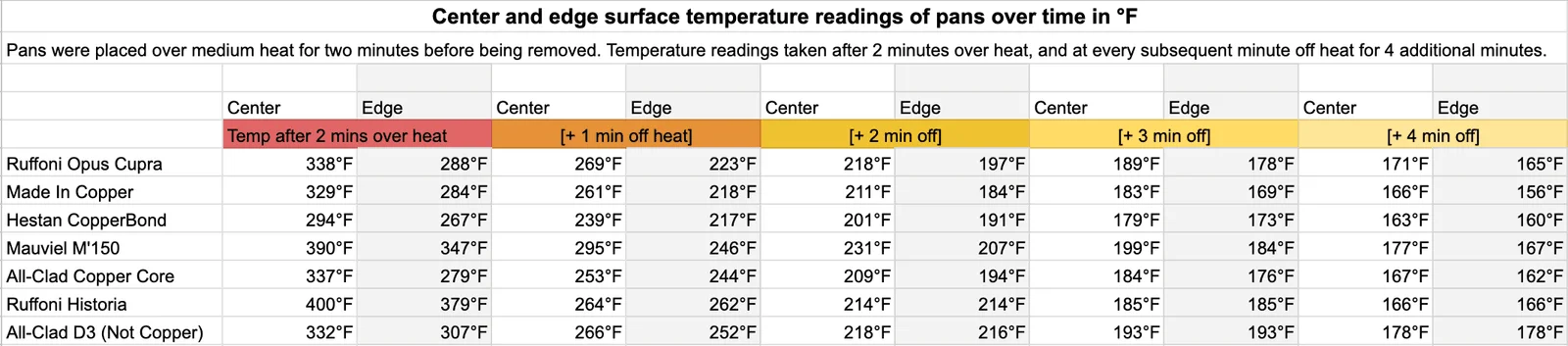
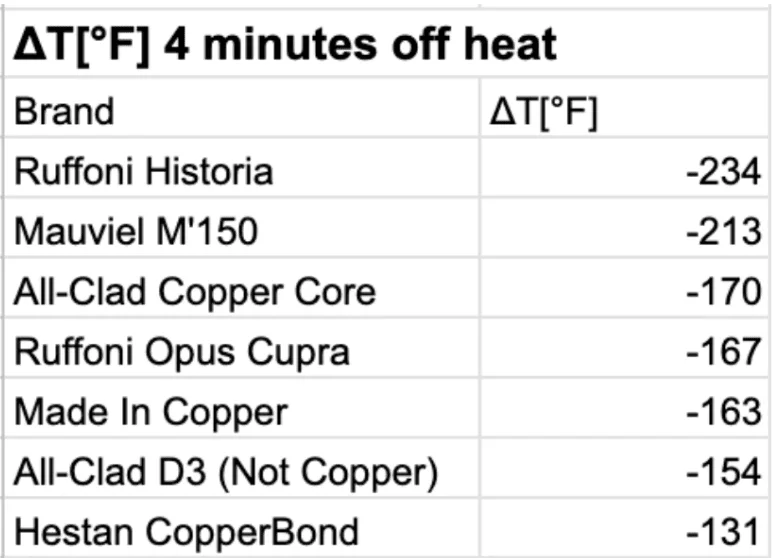
In terms of thermal properties of the pan, the traditional tin-lined Ruffoni Historia was the only pan that demonstrated significantly quicker and more even heating than the stainless steel and aluminum All-Clad D3 pan.
The line graph below shows how quickly the temperature of the pan's cooking surface evened out. The faster a pan reaches 0 on this chart, (meaning a 0°F difference between the center and edge temperatures), the more even-heating that pan is. As demonstrated by the first chart and the graph, the tin-lined Ruffoni Historia pan evened out shortly after the one-minute mark off heat, followed by the All-Clad D3 pan two minutes later. The remaining pans still presented a difference in surface temperature after four minutes off the heat.
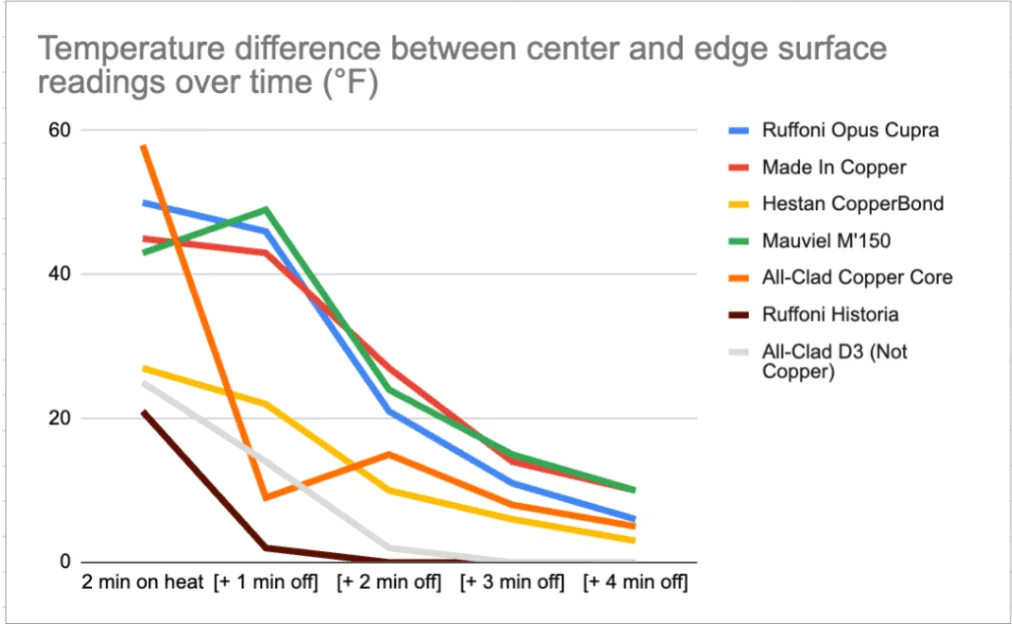
The big takeaway here is, stainless-steel cladding noticeably negates the effectiveness of copper’s thermal conductivity.
Does copper cookware heat up faster than stainless steel cookware?
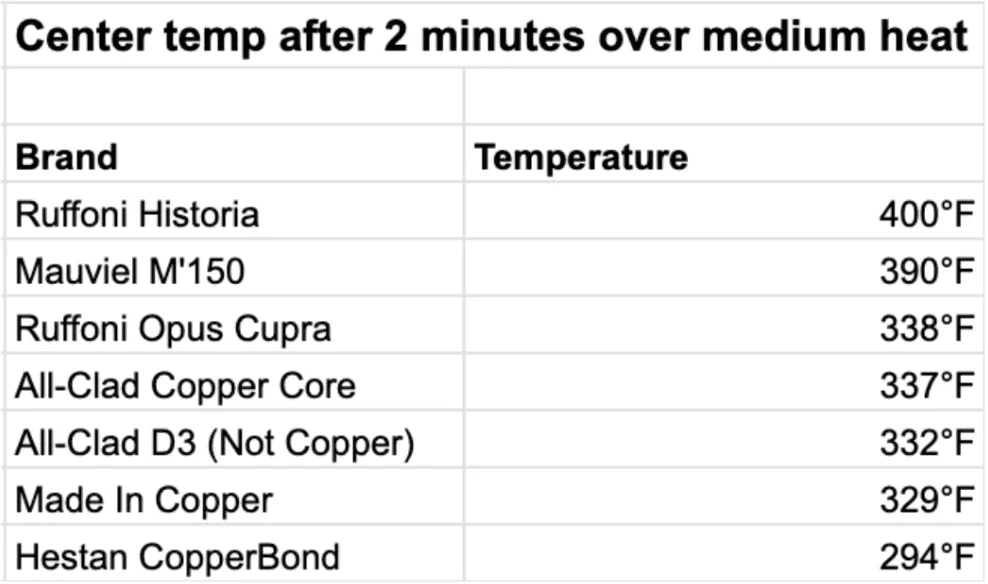
Placing each pan, bare, over medium heat demonstrated that some copper cookware heats quicker and is thus more responsive than a stainless steel and aluminum-clad pan. Once again, the tin lining, having a higher thermal conductivity and lower heat capacity, beat stainless steel, with the Ruffoni Historia heating up and cooling down faster than all other pieces of cookware tested. Of the pans containing stainless steel, only the Mauviel M’150 demonstrated a level of responsiveness noticeably greater than the All-Clad D3. Both the Made In and the Hestan performed worse than the All-Clad D3.
Essential takeaways
1. A copper core isn’t better than an aluminum core.
To put it plainly: Paying significantly more for a stainless-steel pan with a copper core (vs an aluminum one) is not worth it. Comparing the All-Clad Copper Core to the All-Clad D3, the copper heated only marginally faster than the D3, but had a greater variation in temperature across its cooking surface. That means the copper All-Clad pan actually creates a more volatile and scorch-prone cooking experience than its more affordable, aluminum-core counterpart.
This is also where density comes into play. As a material, aluminum is a very efficient thermal conductor, and while it may not be as efficient as copper, it is much less dense, so it makes for much lighter pans. The 3-quart D3 saute pan weighs 3 lbs. 5 oz., about 14% less than the 3-quart Copper Core saute pan (3 lbs. 13 oz.)—and that's just with one layer of copper cladding. If you read around online about copper cookware, you'll see a lot of people touting that thicker is always better with copper for optimal performance over heat, regularly suggesting 2.5mm or more as the ideal. While I wasn't able to get my hands on a Duparquet pan or a heavy-duty vintage pan to test a thicker gauge, the pan with the thickest copper layer (Made In's at 1.8mm) performed sluggishly.
What I'll say is this. In general, I've found that cookware enthusiasts online profess a blanket preference for thicker, heavy cookware. As a cookware tester, I feel that ease of use and maneuverability are just as important when evaluating a pan, so I think lighter cookware shouldn't be discounted, and I think this experiment demonstrated this well.
2. If you want that mythical copper performance, learn to love a tin-lined pan.
For that quick, responsive, and even-heating performance, an old school tin-lined pan is pretty unmatched. As a nonreactive metal coating, tin is lighter, more responsive, and more thermally efficient than stainless-steel.
Once the standard lining for copper cookware, most modern manufacturers of copper cookware have phased out tin in favor of stainless steel because it's far more durable. Tin starts to melt between 450–475°F, which means that you can damage the lining of the pan by overheating it. Because copper pans are so thermally efficient, using high heat isn’t necessary (remember, professional French kitchens have used pans like these for a long time without issue), but it’s something anyone considering copper cookware should bear in mind, especially if they share kitchen equipment with less careful people. Being a softer metal, tin linings can also wear away over time, requiring occasional re-tinning.
Defenders of tin-lined pans will argue that these concerns are generally overblown, and that with proper care, a tin-lined pan can put in a decade or more of work before it’s worn down to the point where relining is required. But comparing that to stainless steel that can last a lifetime, it’s hard to say they are equal.
So what copper cookware should I buy?
Again, we must return to the reason why you want copper cookware. If it’s for the look, go for what you think is beautiful. The worst case scenario is probably that you end up with something that performs a lot like a nice stainless steel-clad pan, only is better looking. But if you want performance, go the old-school route and choose a tin-lined pan. The only cookware I’d really steer clear from would be predominantly stainless-steel cookware that has a layer of copper or a copper core: To quote the immortal words of Freckle, “Sometimes, things that are expensive…are worse.”
Get to know the experts
Wilder Davies: I've been testing pots, pans, and things that go beep in the kitchen for Bon Appétit and Epicurious since 2019. In that time, I've cooked with several hundred pieces of cookware, interviewing chefs, cookware manufacturers, and scientists about the use, care, and maintenance of carbon steel, cast-iron, stainless-steel, and nonstick (I've probably spent too much time thinking about nonstick…) along the way. My coworker Kate calls me "Pan Man."
Michael J Tarkanian MS: Tarkanian is a senior lecturer of material science and engineering at the Massachusetts Institute of Technology. He is a metallurgical engineer and the associate director for MIT's Center for Materials Research in Archaeology and Ethnology and manages the Laboratory for Engineering Materials. He attended MIT for his undergraduate studies before earning his master's degree from the school, and was a recipient of an MIT Excellence Award in 2009.